Ask two engineers which wire rope to use for a crane, and you’ll likely hear a string of numbers back — 6×19, 6×36, 8×19. To someone outside the industry, it sounds like a part number. In reality, it’s the single most important piece of information on a wire rope specification sheet, because it tells you exactly how the rope is going to behave under load, over a sheave, and over years of service.
What "construction" actually means
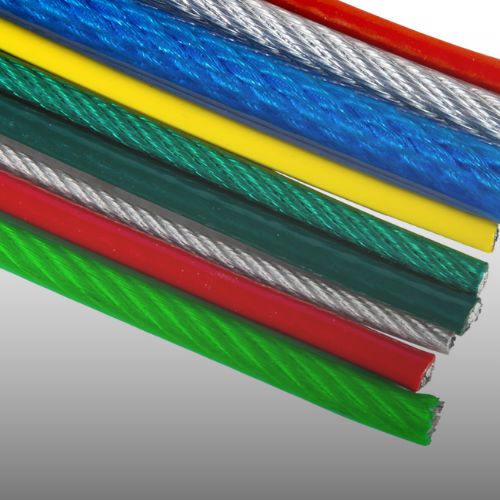
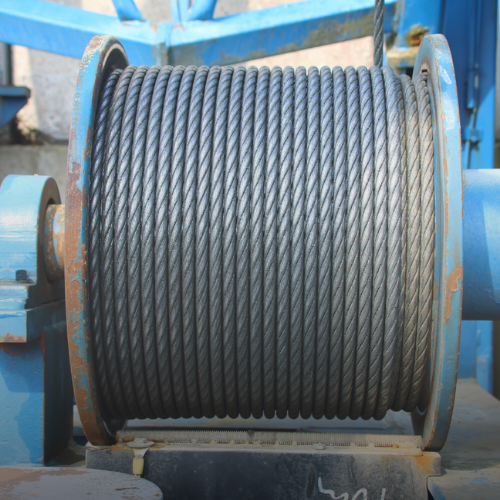
A wire rope is built in two stages. First, individual wires are twisted together into a strand. Then several strands are twisted around a core to form the finished rope. The construction code describes how many strands make up the rope, and how many wires make up each strand — written as (number of strands) x (wires per strand).
Take a standard 6×19 (12/6/1) rope, for example — a construction actually listed in IS 2266, India’s governing standard for steel wire ropes. Read literally: 6 strands, each strand built from 19 wires, arranged as 12 outer wires, 6 inner wires, and 1 centre wire. That inner arrangement isn’t just trivia — it’s what decides how the strand distributes load and resists crushing.
6x7 — stiff, and rarely the right choice for lifting
At the stiff end of the range sits 6×7 construction: fewer, thicker wires per strand. It resists abrasion well but bends poorly, which means it fatigues quickly wherever it runs over a sheave repeatedly. It’s a common — and costly — mistake to specify 6×7 for crane or hoist duty; it belongs in static or near-static applications like guy wires and standing rigging, not on a drum that winds and unwinds all day.
6x19 — the workhorse construction
6×19 class ropes use fewer, thicker wires per strand than finer constructions. That makes them notably resistant to abrasion and crushing — exactly what you want when a rope runs over rough drums, through debris, or drags across the ground, as in haulage and general engineering duty. The trade-off is flexibility: fewer, thicker wires bend less easily than many thin ones, so 6×19 rope is stiffer than its finer-wired cousins. For general crane duty, it remains the most widely specified construction in India.
6x36 — built for flexibility
6×36 class ropes pack more, thinner wires into each strand. More wires means the rope bends more easily around smaller sheaves and drums without fatiguing as fast — ideal for cranes, hoists, and elevators where the rope runs over pulleys constantly. The trade-off runs the other way: thinner wires wear down faster when exposed to abrasive surfaces or grit, so 6×36 rope suits controlled, mechanical environments better than ground-dragging applications.
8x19 — extra flexibility for tight bends
Add two more strands and you get 8×19 construction — more flexible again than 6×19 or 6×36, at some cost to breaking strength for a given diameter. This construction shows up in applications needing very small sheave diameters or repeated tight bending, such as certain elevator and hoist setups.
Core type: a second decision layered on top of construction
Construction tells you the strand arrangement; core type is a separate decision entirely. A Fibre Core (FC) rope uses a synthetic or natural fibre centre — lighter, and it cushions the strands, but offers no independent strength contribution. An Independent Wire Rope Core (IWRC) replaces that fibre centre with a small wire rope of its own, adding roughly 7–10% more minimum breaking load compared to the same construction with a fibre core, along with better resistance to crushing and heat. Most crane and hoist applications specify IWRC for exactly that reason; FC is chosen mainly where extra flexibility or a lighter rope matters more than the strength gain.
Wire grade — the dimension people forget to check
Beyond construction and core, IS 2266 also specifies wire tensile grade — commonly 1570, 1770, or 1960 MPa. A higher grade doesn’t just mean a stronger rope at the same diameter; it usually costs more too, so specifying 1960 MPa wire for a general-duty application where 1770 MPa comfortably meets the load requirement is a common and avoidable way to inflate cost without adding real value. Matching grade to actual design load, not defaulting to the highest number available, is part of a correctly specified rope.
How to choose between them
FAQ
Q: Is a 6×36 rope stronger than a 6×19 rope of the same diameter? Not necessarily. Strength depends primarily on wire grade and total steel cross-section, not construction alone. 6×36 is generally more flexible; 6×19 is generally more abrasion-resistant, at broadly similar strength for the same diameter and grade.
Q: What does IWRC actually add to a rope? An Independent Wire Rope Core typically adds around 7–10% more minimum breaking load compared to the same construction with a fibre core, along with better resistance to crushing and heat — which is why it’s the default choice for most crane and hoist duty.
Q: Can I substitute one construction for another to save cost? Only if the substitute meets the bending, abrasion, and load requirements of the original design. A 6×7 rope substituted onto crane duty to save cost, for instance, will typically fail from bending fatigue far sooner than the correct construction. Always confirm with the equipment manufacturer or a wire rope engineer before substituting.
Q: Where is the exact construction of a rope specified? It’s listed on the rope’s IS 2266 test certificate, along with its core type, wire grade, and minimum breaking load — always ask your supplier for this document rather than relying on a general product description.