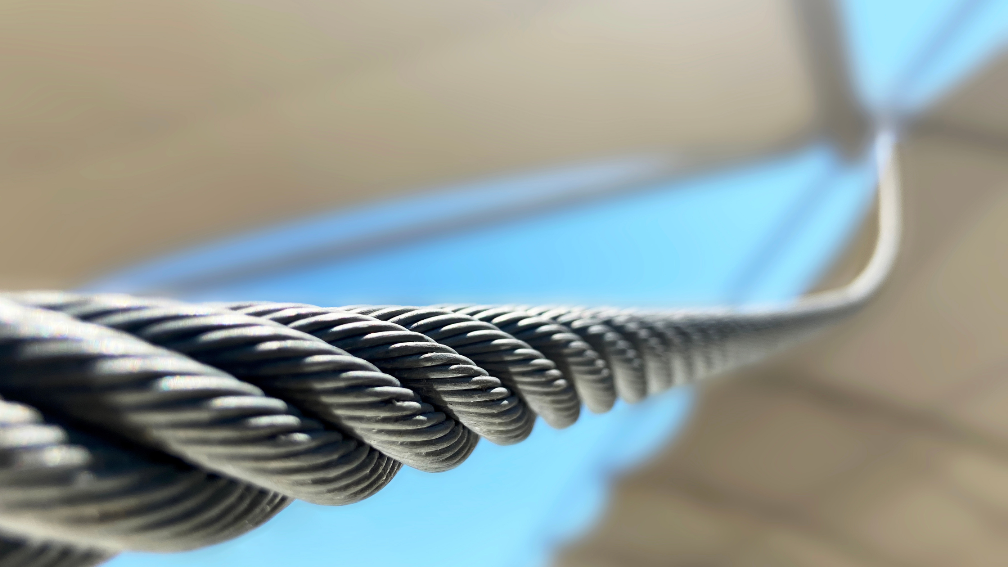
A wire rope is only as strong as its weakest point — and more often than not, that weak point isn’t the rope itself, it’s the end. Whatever fitting connects a rope to a hook, drum, or anchor point directly affects how much of the rope’s rated strength you actually get to use, and how safely.
Thimbles: protecting the eye, not adding strength
A thimble is a grooved metal insert placed inside a rope eye before it’s secured, so the rope bends around a smooth, defined radius rather than a sharp fitting edge. Thimbles don’t provide strength on their own — their job is to prevent the rope from kinking or wearing against whatever it’s connected to, extending the life of that critical eye section significantly. Almost every other termination method on this list is normally used together with a thimble, not instead of one.
Swaged (pressed) ferrules — near-full strength retention
A swaged ferrule is a metal sleeve pressed onto the rope with hydraulic force, permanently compressing it around the rope strands to form a secure, high-strength termination. Correctly applied with the manufacturer-specified die size, a swaged termination is generally rated at 100% efficiency of the rope’s breaking strength — meaning it retains essentially the rope’s full rated strength, provided the fitting is correctly sized and installed. This is why it’s the standard choice for permanent slings, crane ropes, and most industrial applications. One caution: swaged sockets are generally not recommended for fibre-core or lang-lay rope, so construction and core type need to be confirmed before this termination is chosen.
Resin and spelter (poured) sockets — the other 100% option
In a poured socket, the rope’s individual wires are splayed open (“broomed”) inside a conical socket cavity and set in place with a poured resin compound or molten zinc, locking every wire mechanically as the fill cures or solidifies. Correctly made, this is also generally rated at 100% efficiency of the rope’s breaking strength, and it’s commonly used in mining, marine, and other critical heavy-lift applications where full strength retention is essential. It requires more preparation time than swaging or a wedge socket, since the poured compound needs to cure before the termination can be loaded.
Wedge sockets — fast, field-adjustable, lower efficiency
A wedge socket clamps the rope by wedging it between a tapered housing and a matching wedge — the harder the rope is pulled, the tighter the grip. It’s fast to install and remove on site without special tooling, which makes it popular for mobile cranes, draglines, and drilling applications where ropes are shortened or re-terminated periodically. The trade-off is efficiency: a correctly installed wedge socket is generally rated around 80% of the rope’s breaking strength, meaningfully lower than a swaged or poured termination. Installation technique also matters more here — an incorrectly seated wedge reduces effective strength further, so this termination depends more heavily on correct field procedure than a permanent, shop-made fitting does.
Wire rope clips — useful, but the least efficient common option
Wire rope clips (U-bolt style) clamp a folded-back rope end to itself to form a temporary or semi-permanent eye. They’re inexpensive, simple to install with basic tools, and widely used for lower-criticality or temporary rigging — but they generally deliver lower termination efficiency than swaged, poured, or wedge terminations, and their strength depends heavily on correct clip spacing, orientation (“never saddle a dead horse” is the traditional rigger’s rule — the U-bolt goes on the short, dead end, never the live end), and torque. For any permanent, high-load, or life-safety application, clips are generally not the right choice compared with a proper socket or swaged termination.
Matching the termination to the application
As a practical guide: for permanent, high-load, or life-safety terminations — crane ropes, slings, critical lifting points — swaged ferrules or poured sockets are the right choice at close to full rope strength. For applications needing field adjustment or periodic re-termination, such as mobile crane hoist lines, a wedge socket’s convenience often outweighs its lower efficiency, provided the rope is specified with that efficiency loss accounted for. Wire rope clips are best reserved for temporary or lower-criticality rigging, not as a substitute for a proper socket on anything load-bearing and permanent.
Why the termination method deserves as much attention as the rope
It’s common for buyers to specify rope construction, diameter, and grade carefully, then leave the end termination to whatever the installer has on hand. That’s a mistake — an incorrectly chosen or poorly installed termination can undo the value of an otherwise perfectly specified rope, since the termination efficiency directly reduces the usable strength of the whole assembly, not just the fitting itself.
Bedmutha, a wire rope manufacturer in India, supplies ropes with the correct termination already fitted and tested for the application, removing the guesswork around on-site fitting quality.
FAQ
Q: Which termination retains the most rope strength? Correctly made swaged ferrules and poured (resin or spelter) sockets both typically retain around 100% of the rope’s rated breaking strength, which is why they’re preferred for critical, high-load applications.
Q: How efficient is a wedge socket compared to a swaged fitting? A correctly installed wedge socket is generally rated around 80% of the rope’s breaking strength, against roughly 100% for a swaged or poured termination — the wedge socket trades some strength efficiency for field-installation speed and adjustability.
Q: Can I reuse a wedge socket when replacing a rope? The wedge socket hardware itself can often be reused if undamaged, but always inspect the wedge and housing for wear or deformation before reinstalling with a new rope, and follow the manufacturer’s guidance on installation technique.
Q: Are wire rope clips safe to use? They’re widely used for temporary and lower-criticality rigging when correctly spaced, oriented, and torqued, but they generally deliver lower termination efficiency than a proper socket and shouldn’t substitute for one on permanent or high-consequence lifting points.